

Luxury Metal Business Cards: How Cutting Edge Technology Adds Value to Premium Metal Cards
For luxury brands, financial service providers, private clubs, hotels, creative agencies, and corporate sales teams, a business card does more than share contact information. It represents the company’s positioning, service level, and attention to detail.
This is why more organizations are replacing conventional paper cards with Luxury Metal Business Cards. However, a metal card is not automatically premium simply because it is heavier or more expensive. Its real value depends on material selection, design manufacturability, finishing consistency, edge safety, optional smart functions, and the supplier’s ability to reproduce an approved sample across a full production run.
For B2B buyers, these factors should be evaluated before comparing quotations.
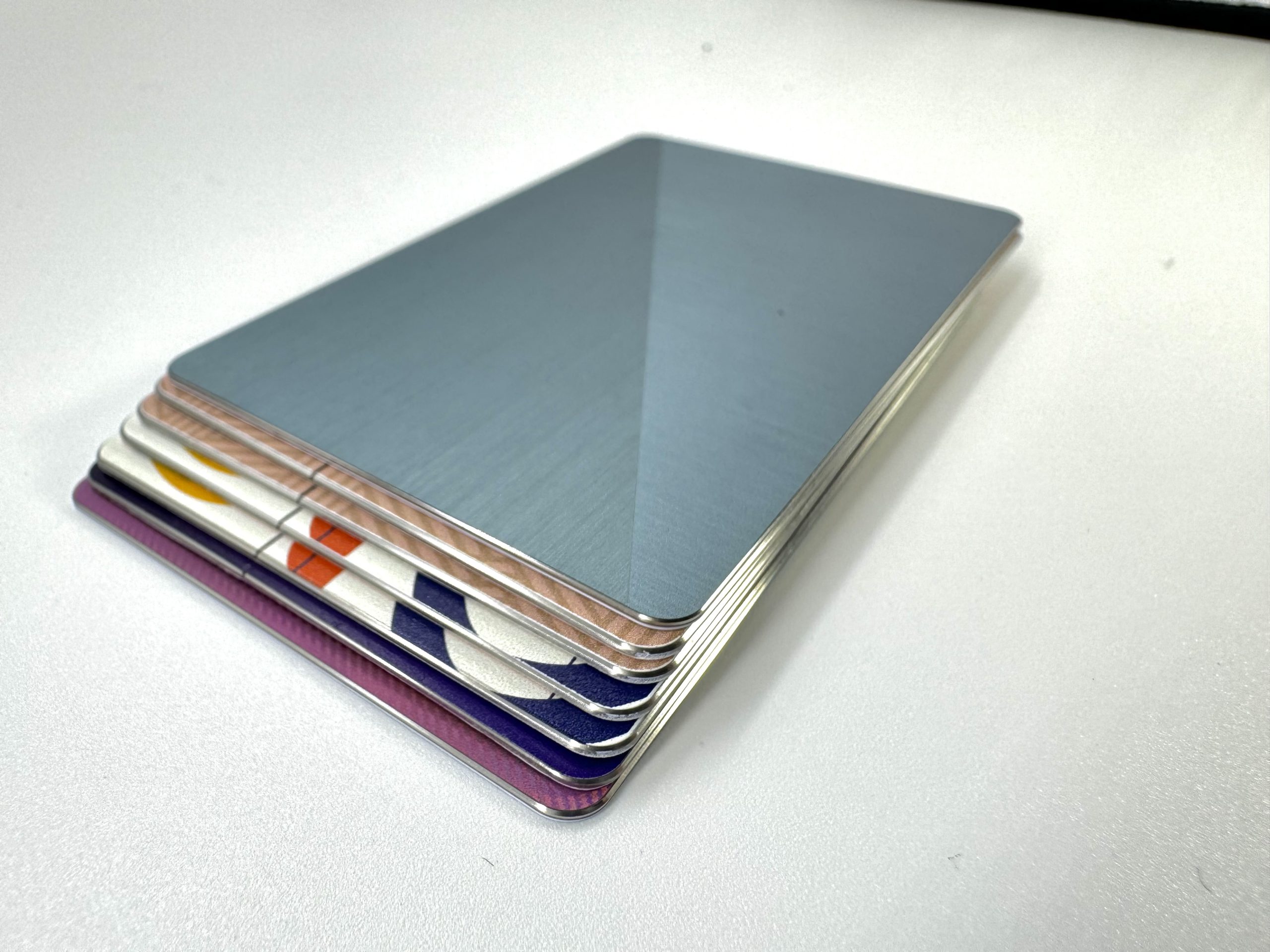
Why Are Businesses Choosing Luxury Metal Business Cards?
Paper business cards remain practical for large-scale distribution, but they provide limited opportunities to create weight, texture, dimensional detail, and long-term durability. Metal offers a different physical experience through its temperature, rigidity, surface finish, and distinctive feel.
Luxury Metal Business Cards are commonly used for:
- Executive and corporate business cards
- Luxury retail, jewelry, automotive, and real estate brands
- Hotels, private clubs, and VIP membership programs
- Product launches, investment events, and trade shows
- Limited-edition invitations and customer gifts
- NFC-enabled digital business cards
- Authentication, loyalty, and membership applications
For procurement teams, the objective is not simply to purchase a card that looks expensive. The card must communicate the intended brand image while remaining practical to carry, distribute, scan, store, and reorder.
What Determines the Quality of Premium Metal Cards?
1. Select the Metal According to the Application
Different metals offer different levels of weight, hardness, color, corrosion resistance, and processing flexibility. Buyers should therefore choose a material according to the intended application rather than relying only on product images.
| Material | Main Characteristics | Suitable Brand Positioning | Procurement Considerations |
|---|---|---|---|
| Stainless steel | Stable, durable, and compatible with multiple finishes | Technology, finance, consulting, and corporate services | Material grade, surface texture, edge finishing, and corrosion resistance |
| Brass | Naturally warm golden tone with a substantial feel | Hotels, private clubs, jewelry, and heritage brands | Oxidation control, surface protection, and color consistency |
| Copper | Distinctive reddish tone that develops a unique appearance | Creative studios, art projects, and limited editions | Oxidation, fingerprints, storage conditions, and protective coating |
| Titanium or titanium alloy | High strength and a technical appearance | Premium technology, aviation, and specialist services | Processing method, surface color, weight, and project cost |
Cards described using the same material name may still differ significantly in color, hardness, flatness, and surface quality. Buyers should request actual material samples or finished prototypes before approving bulk production.
2. Balance Thickness, Weight, and Daily Usability
A thicker card may create a stronger sense of value, but it can also increase packaging costs, shipping weight, and carrying inconvenience. The thickest option is not necessarily the best option.
Before confirming the specification, buyers should consider:
- Will the card be used daily or presented only to selected clients?
- Must it fit inside a standard wallet or cardholder?
- How many cards will each representative carry?
- Will the cards be mailed internationally?
- Does the construction include an NFC or RFID inlay?
- Could the edges or cut-out areas affect safe handling?
The card’s thickness and construction should be determined by its intended use, not by weight alone.
How Cutting Edge Technology Improves Metal Card Production
The value of Cutting Edge Technology in metal card manufacturing lies in processing precision, complex design execution, and repeatability across bulk orders. It should deliver measurable improvements rather than decorative features with no practical purpose.
Precision Etching and Laser Processing
Chemical etching can create text, patterns, recessed areas, and multiple visual depths. Laser processing can be used for detailed marking, controlled engraving, outlines, and selected cut-out structures.
The right process depends on the metal, line thickness, design complexity, finish, and order quantity. During the design review, the supplier should evaluate:
- Whether small text will remain legible
- Whether thin lines and negative spaces can be produced consistently
- Whether cut-out areas have sufficient structural connections
- Whether QR codes have enough contrast for reliable scanning
- Whether front and back graphics can be aligned correctly
- How the base metal color will affect printed or engraved details
- Whether the design can be reproduced consistently in future orders
A design that looks clear on a computer screen may not be suitable for stable metal production. A design-for-manufacturing review should therefore take place before tooling, sampling, or bulk production.
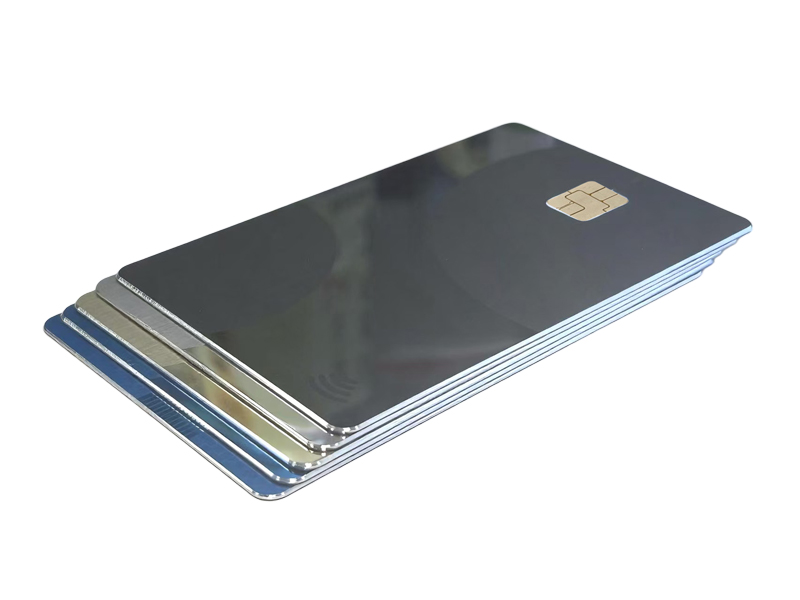
Brushed, Matte, Plated, and Textured Finishes
A brushed finish creates a directional metallic texture, while a matte finish reduces strong reflections. Gold-tone or silver-tone plating can reinforce a luxury appearance, but the visual result depends heavily on surface preparation and process control.
When inspecting Premium Metal Cards, buyers should check:
- Color consistency between individual cards
- Direction and uniformity of brushed textures
- Scratches, stains, fingerprints, or visible surface defects
- Finish coverage around edges and cut-out areas
- Clarity of logos and small text
- Adhesion and durability of coatings or plated finishes
- Consistency between the approved sample and the production batch
If the brand has strict color requirements, a physical master sample should be used as the approval standard. Screen colors, printing references, and the final appearance of a metallic surface are not always identical.
How Can NFC Turn a Metal Business Card into a Digital Touchpoint?
Premium metal cards can incorporate NFC or RFID functions that connect users to a corporate website, digital business profile, product catalog, booking page, membership portal, or CRM workflow.
However, metal can interfere with radio-frequency performance. An NFC metal card cannot be developed by simply placing a conventional NFC tag inside a metal body. The antenna, chip position, shielding or isolation material, and overall card structure must be designed together.
RealSmart provides technical support for RFID inlay design, antenna tuning, chip selection, special card construction, and production readiness. These capabilities can help buyers evaluate a metal card project before proceeding to mass production. Learn more about RealSmart’s consulting and design support.
For NFC-enabled Luxury Metal Business Cards, buyers should confirm:
- Compatibility with the intended mobile phones and operating systems
- Location and accessibility of the tapping area
- Whether the destination URL can be updated later
- Whether each card requires individual encoded information
- UID, serial number, or database-binding requirements
- Reading performance before and after packaging
- Batch testing or individual testing procedures
- Data verification and duplicate-prevention methods
If the card is intended for access control, secure identification, or payment, additional chip, security, system integration, and compliance requirements must be evaluated. A basic NFC card that opens a website should not be treated as a secure access or payment credential.

How Should B2B Buyers Evaluate a Prototype?
A prototype should not be approved only because it looks attractive. Buyers should establish measurable criteria covering appearance, structure, and function.
Appearance Inspection
Check the following details:
- Metal color and surface texture
- Logo, text, and graphic clarity
- Front-to-back positioning
- Plating or coating coverage
- Scratches, stains, or visible color variation
- Consistency of engraved or etched depth
Structural Inspection
The inspection should include:
- Dimensions, thickness, and weight
- Flatness and resistance to unwanted bending
- Corner smoothness
- Strength around cut-out areas
- Burr-free and safe edges
- Compatibility with the intended wallet, holder, or packaging
Functional Inspection
For cards with digital or variable features, test:
- QR-code scanning under different lighting conditions
- NFC reading on representative target devices
- Accuracy of encoded links and data
- Duplicate or missing data across multiple samples
- Reading performance after the card is placed in its packaging
- Consistency after repeated tapping and normal handling
Once approved, the prototype should be retained as a Golden Sample. The material, color, surface finish, graphics, construction, and functional performance of the bulk order should be evaluated against this sample.
What Information Should Be Included in an RFQ?
A complete request for quotation helps suppliers provide accurate pricing and reduces repeated communication. Buyers should include:
- Intended application and target market
- Estimated order quantity and reorder forecast
- Card dimensions, shape, and preferred thickness
- Preferred metal material
- Surface color and texture requirements
- Etching, engraving, cut-out, or plating requirements
- Front and back design files
- NFC or RFID requirements
- Variable data, QR code, or serial number requirements
- Individual packaging or presentation box requirements
- Required sample and delivery schedule
- Inspection criteria and target budget
A low quotation based on an incomplete specification may not be comparable with other offers. Suppliers may be quoting different materials, thicknesses, finishes, testing procedures, or packaging methods.
Why Unit Price Should Not Be the Only Comparison
The total cost of Premium Metal Cards may include design adjustment, tooling, sampling, surface treatment, NFC chips, data encoding, personalization, inspection, packaging, and international transportation.
Procurement teams should compare the total landed project cost instead of focusing only on the quoted price per card. A lower unit price can become more expensive if the order suffers from color variation, poor edge finishing, functional failures, production delays, or repeated rework.
Before placing an order, confirm:
- MOQ and quantity-based pricing
- Sampling and tooling charges
- Whether sample fees can be credited against the order
- When the production lead time officially begins
- Costs associated with artwork revisions
- Variable-data submission and verification procedures
- Defect criteria and replacement arrangements
- Color and finish consistency for repeat orders
- Inspection reports available before shipment
- Packaging and international shipping responsibilities
These points make quotations easier to compare and reduce disputes after production has started.
How RealSmart Supports Custom Metal Card Projects
RealSmart specializes in smart cards, NFC wearables, premium metal cards, and related RFID solutions. Its technical capabilities cover design consulting, inlay development, special card structures, chip-related processes, testing support, and production scale-up. Learn more about RealSmart.
For businesses, design agencies, membership operators, and card solution providers developing Luxury Metal Business Cards, RealSmart can review the intended application, artwork, card structure, surface requirements, and NFC/RFID functions before production.
This approach allows buyers to identify manufacturability problems during the design and sampling stages rather than after a full order has been produced.
From an Approved Sample to Consistent Repeat Orders
Producing one attractive prototype does not prove that a supplier can deliver an entire order consistently. For hotels, luxury brands, design agencies, and membership operators, the greater challenge is ensuring that the first order and every later reorder retain the same material, color, texture, engraving depth, edge quality, and NFC performance.
Before mass production, buyers should establish a physical Golden Sample, key inspection criteria, acceptable tolerances, testing procedures, and a clear process for handling defective products. Long-term Premium Metal Cards programs should also address material batch control, artwork retention, production records, and the supplier’s ability to reproduce previous finishes.
RealSmart can evaluate a project according to its branding purpose, visual requirements, card construction, and smart functionality. Buyers can submit their design files, expected quantity, application, and technical requirements for manufacturability review and sampling. This creates a clearer path from an initial design concept to a metal card that can be produced, inspected, delivered, and reordered with greater consistency.
-
 2026-08-17
 -

-
 2026-06-16